
Jackson County Launches Public Safety Radio System With Reach Into Neighboring Counties
A new public safety radio system serving Jackson County and portions of neighboring counties, including Douglas County, launched October 6 to improve communications between dispatchers and first responders.
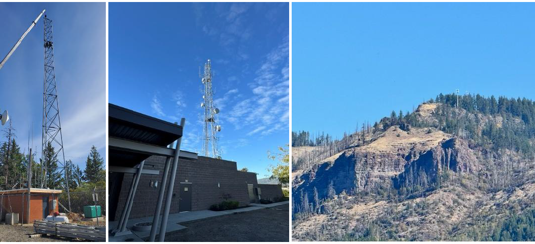
A new public safety radio system serving Jackson County and portions of surrounding counties, including Douglas County, went live October 6 after more than a decade of planning and construction.
Emergency Communications of Southern Oregon, known as ECSO 911, launched the system to improve communications between dispatchers and first responders. ECSO is the primary 911 center for Jackson County and Crater Lake National Park.
The system also supports radio communications across portions of Curry, Klamath, Josephine, and Siskiyou counties in California. The upgrade affects the radios used by public safety agencies and does not change residents’ ability to call or text 911.
According to the Oregon Department of Emergency Management, the system is designed to improve daily operations and help agencies communicate during mutual aid calls and emergencies involving multiple jurisdictions, including in remote areas.
The project began with a 2014 Department of Homeland Security grant awarded to Jackson County Fire District 3 to study public safety radio infrastructure. A conceptual design process in 2016 identified a P25 hybrid radio system as the preferred approach.
Jackson County voters approved a $28 million general obligation bond for the project in 2019. A contract with Motorola Solutions followed in 2020.
Construction included 20 new or upgraded radio sites, with solar power used at remote locations. That work was completed in 2025. Agencies received approximately 1,700 to 1,800 radios, and extensive testing preceded the October 6 switchover.
“Interoperable, reliable communications save lives,” said Jon Lee, OEM’s statewide interoperability coordinator.
OEM’s interoperability and preparedness teams worked with ECSO, Jackson County, and state and federal agencies on technical coordination, grant alignment, and compatibility with existing and future emergency communications infrastructure. That work also included planning through the State Interoperability Executive Council as the project expanded to include new technology and additional backup capabilities.
Other support came from the Oregon Legislature, federal grant programs, the Oregon Department of Transportation, Oregon State Police, and local public safety agencies.
OEM said coordination will continue among ECSO, fire and law enforcement agencies, and county service departments as they work through the transition and make further adjustments to system performance.

Comments ()